Series Roadmap
| # | Topic | Status |
|---|---|---|
| 0 | Overview & Comparison — vLLM, SGLang, TensorRT-LLM | ✅ |
| 1 | vLLM Deep Dive | |
| 2 | SGLang Deep Dive | |
| 3 | TensorRT-LLM Deep Dive |
The overview post introduced PagedAttention and Continuous Batching at a conceptual level. This post covers the internal structure of vLLM V1 (default since v0.8.0) — its multi-process architecture, Scheduler, KVCacheManager, and parallelism strategies.
1. What is vLLM?
vLLM is an open-source LLM serving framework released by UC Berkeley in 2023. It is built on the PagedAttention paper presented at SOSP 2023, with the primary goal of maximizing inference throughput in both single-GPU and distributed environments.
Three core contributions define vLLM:
- PagedAttention: Manages KV Cache memory using OS-style paging, eliminating memory waste
- Continuous Batching: Removes completed requests and inserts new ones at each iteration boundary
- Multi-hardware support: NVIDIA, AMD (ROCm), Google TPU, AWS Inferentia
2. Overall Architecture
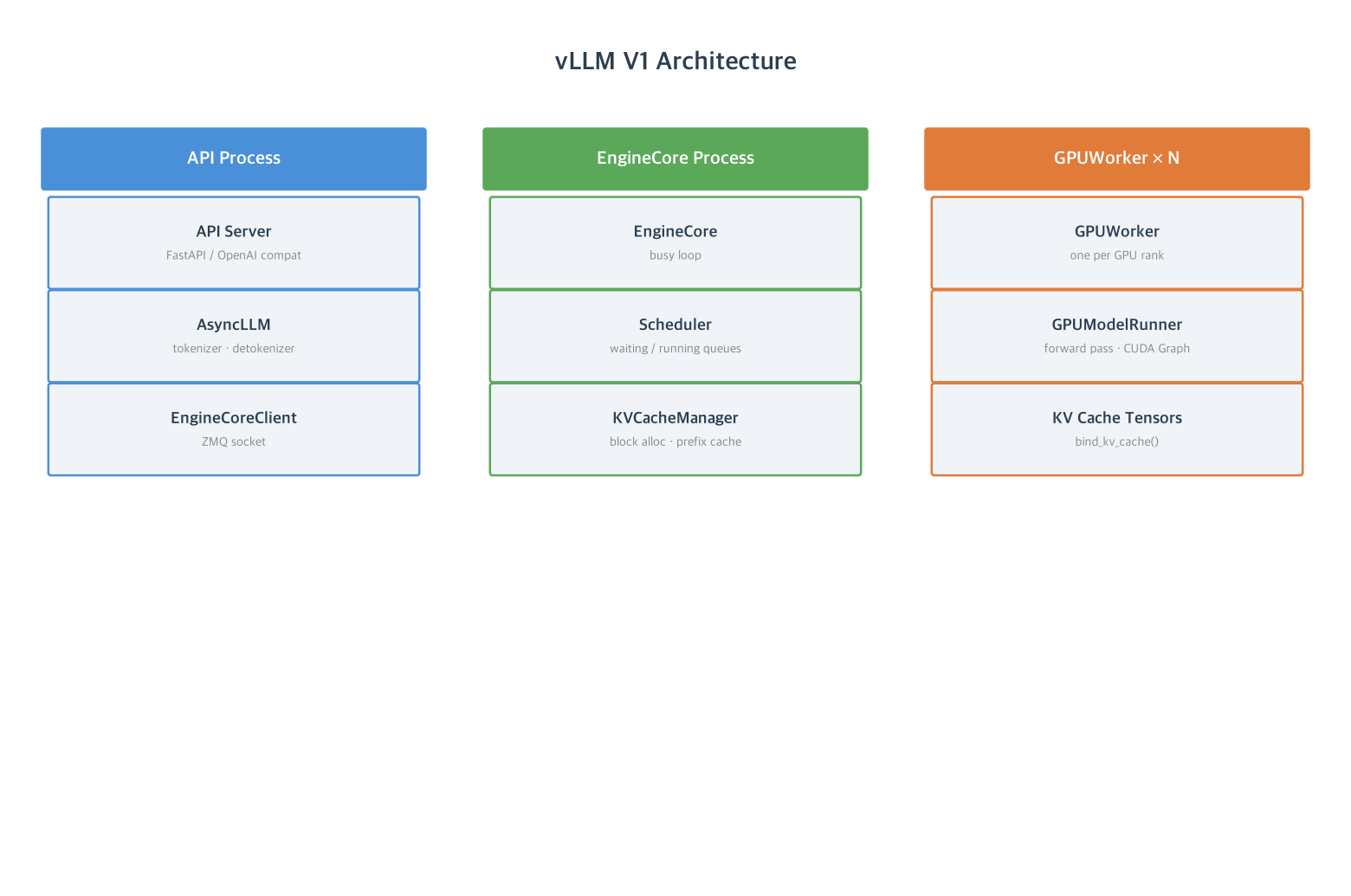
V1 is a multi-process architecture. Three process types handle distinct responsibilities:
HTTP Request
    ↓
[API Server]          ─── FastAPI, OpenAI-compatible
    ↓
[AsyncLLM]            ─── tokenize · detokenize · stream   (main process)
    │  ZMQ socket
    ↓
[EngineCore]          ─── scheduling · KV management loop  (separate process)
    ├── [Scheduler]           ─── request scheduling, preemption
    │       └── [KVCacheManager]  ─── block alloc · prefix cache
    └── [MultiprocExecutor]
            └── [GPUWorker × N]   ─── one process per GPU
                    └── [GPUModelRunner]  ─── model forward pass
The most significant change from V0 is that EngineCore now runs in a separate process. AsyncLLM and EngineCore communicate via ZMQ sockets, letting each run its own loop independently — free from Python GIL contention.
3. Frontend
API Server
vllm.entrypoints.openai.api_server runs a FastAPI HTTP server. The /v1/chat/completions and /v1/completions endpoints implement the OpenAI API spec exactly, allowing existing OpenAI SDK clients to work without modification.
AsyncLLM
AsyncLLM (vllm/v1/engine/async_llm.py) is V1’s async entry point. It serves three roles:
- Accepts concurrent requests, tokenizes them, and forwards them to
EngineCore - Receives output tokens from
EngineCoreand detokenizes them - Streams tokens back to clients via
AsyncGenerator
EngineCore runs as a separate process (EngineCoreProc). AsyncLLM sends requests and receives outputs through EngineCoreClient over ZMQ. Separating I/O processing from the scheduling loop means a slow tokenizer or streamer no longer stalls inference.
4. Scheduler and KVCacheManager
Scheduler
The Scheduler (vllm/v1/core/sched/scheduler.py) manages two queues:
waiting  ─── requests not yet started
running  ─── requests currently executing on GPU
Swap preemption has been removed in V1. When memory pressure requires preemption, KVCacheManager frees the request’s blocks and the request returns to the waiting queue for Recompute — prefill is re-executed when resources become available.
Chunked Prefill is always enabled in V1. Long prompts are split into chunks of max_num_batched_tokens and batched together with decode requests. This prevents a single long prefill from blocking decode iterations and allows fine-grained control over TTFT / TPOT tradeoffs.
KVCacheManager
KVCacheManager (vllm/v1/core/kv_cache_manager.py) is the memory manager behind PagedAttention — the V1 counterpart of V0’s BlockSpaceManager.
Logical Block         →  Physical Block
  [req A: block 0]   →  [GPU block #42]
  [req A: block 1]   →  [GPU block #7 ]
  [req B: block 0]   →  [GPU block #42]  ← shared prefix
Key operations:
allocate_slots(): assign new token slots for a running requestfree()/free_slots(): return blocks when a request completes or is preempted- Hash-based prefix caching: blocks are identified by a content hash; identical prefixes are reused automatically. Enabled by default in V1.
Internally, KVCacheCoordinator coordinates per-layer-type SingleTypeKVCacheManager instances, supporting heterogeneous attention (e.g., some layers use sliding-window attention, others use full attention).
5. Worker
MultiprocExecutor
Worker coordination in V1 is handled by MultiprocExecutor. It spawns the required number of GPUWorker processes based on the TP/PP configuration and broadcasts execution commands to each.
GPUWorker
GPUWorker (vllm/v1/worker/gpu_worker.py) corresponds to one GPU rank. During initialization it loads model weights and partitions them according to the TP/PP configuration. KV Cache tensors allocated by EngineCore are passed down via bind_kv_cache() and bound to GPUModelRunner.
GPUModelRunner
GPUModelRunner (vllm/v1/worker/gpu_model_runner.py) executes the actual forward pass:
- Input preparation: construct token IDs, position IDs, and attention metadata (block table, context lengths)
- CUDA Graph or eager execution: for the decode phase with small, fixed batch sizes, CUDA Graph captures reduce kernel launch overhead
- Model forward: pass through attention → FFN → LayerNorm per layer
- Sampling: apply temperature, top-p, top-k to logits and select the next token
KV Cache tensors are allocated by EngineCore at startup — it profiles available GPU memory and reserves per-layer KV tensors in bulk. GPUModelRunner binds these tensors via bind_kv_cache() and accesses them directly during the forward pass. V0’s CacheEngine (with swap_in / swap_out) has been removed in V1 and replaced by the Recompute preemption strategy.
6. Transfer Layer
Inter-Worker Communication (NCCL)
When TP or PP is active, Workers communicate via NCCL:
| Parallelism | Collective | Trigger |
|---|---|---|
| Tensor Parallel | all_reduce |
after each attention + FFN layer |
| Pipeline Parallel | send / recv (P2P) |
at each stage boundary |
| Expert Parallel | all_to_all |
MoE token routing |
Disaggregated Prefill (P/D Separation)
Disaggregated Prefill separates the prefill and decode phases into distinct instances:
Prefill Instance               Decode Instance
─────────────────              ─────────────────
prompt → prefill compute       receive KV Cache
generate KV Cache    ───────→  iterate decode
                  KV Transfer  stream tokens back
Because prefill is compute-bound and decode is memory-bandwidth-bound, separating them allows each phase to be deployed on hardware (or configuration) optimized for its bottleneck.
vLLM abstracts this transfer layer through the KVConnector interface. Implementations like Mooncake and nixl exist; custom connectors can also be written to plug into the interface.
7. Supported Parallelism
Tensor Parallelism
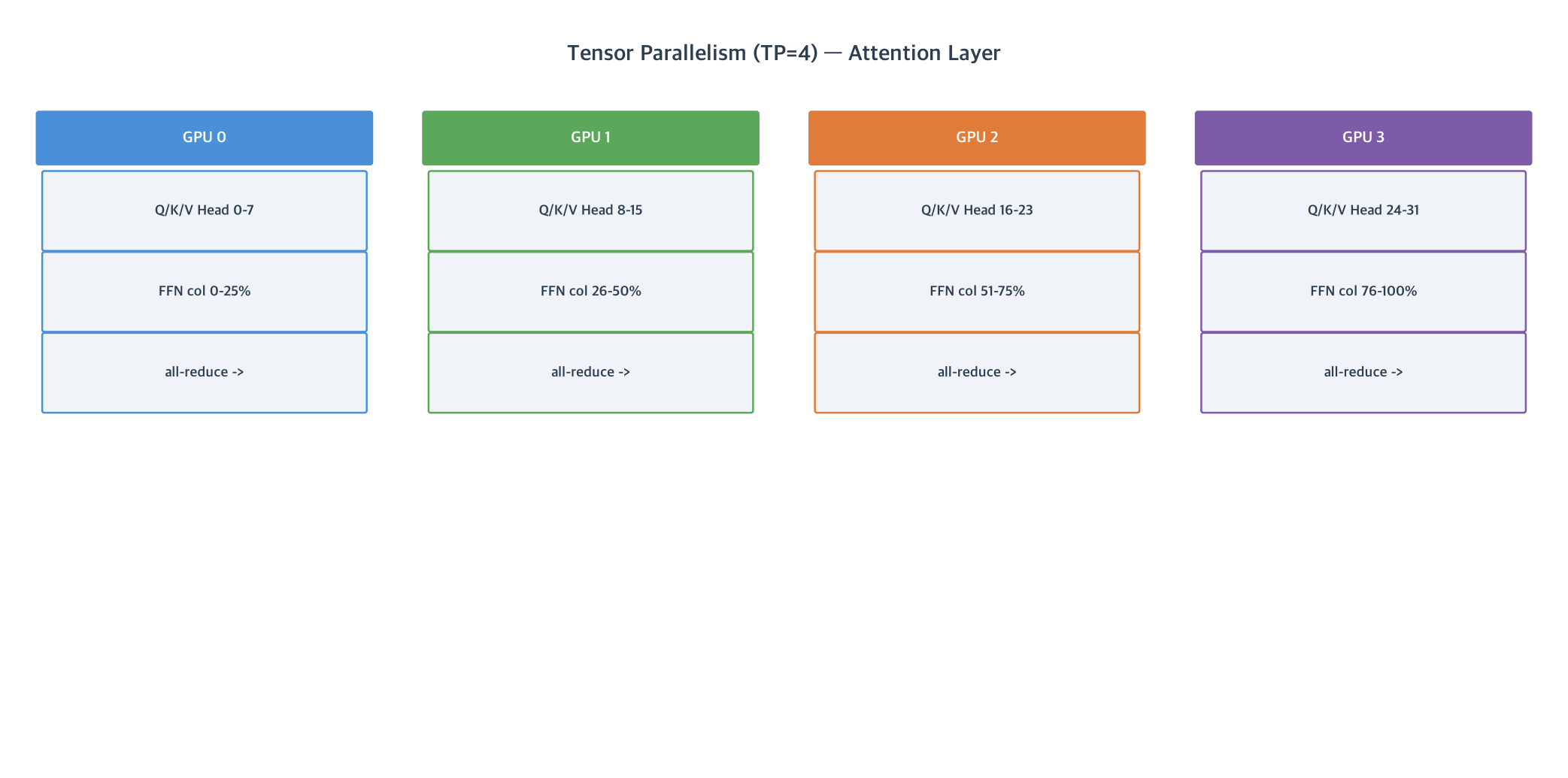
Tensor Parallelism (TP) distributes individual layer computations across GPUs.
- Attention: Q/K/V projections split by head (
ColumnParallelLinear). Each GPU computes attention for its assigned heads and contributes to a finalall_reduce. - FFN: up-projection uses column parallel; down-projection uses row parallel. Both terminate in
all_reduce.
all_reduce fires at every layer, so communication bandwidth is the limiting factor. TP is recommended within a single node over NVLink. Cross-node TP over InfiniBand is possible but incurs higher communication overhead.
vllm serve meta-llama/Llama-3-70B \
  --tensor-parallel-size 4
Pipeline Parallelism
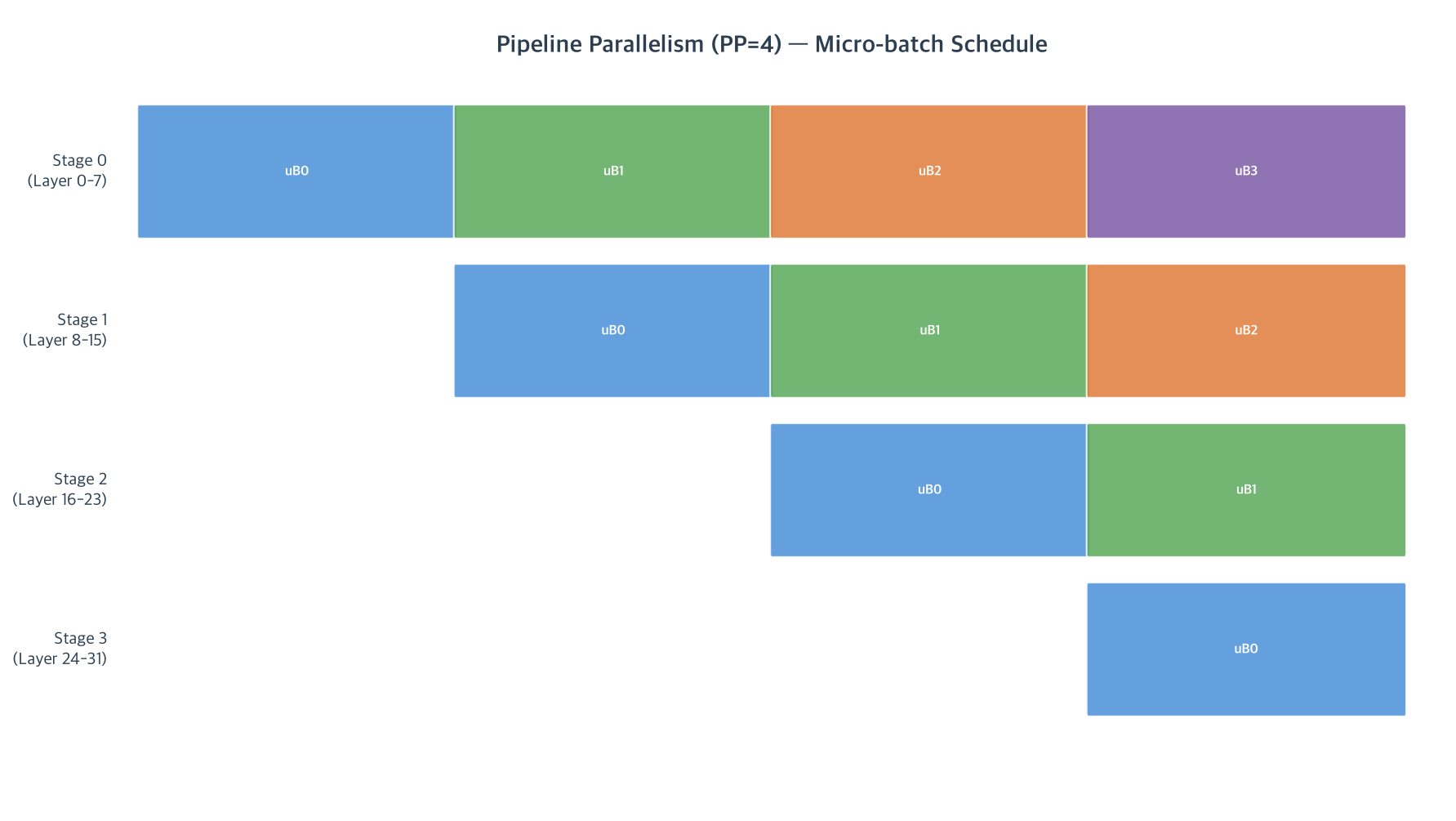
Pipeline Parallelism (PP) splits Transformer layers into stages, one per GPU.
Stage 0 (Layer 0-7) → Stage 1 (Layer 8-15) → Stage 2 (Layer 16-23) → Stage 3 (Layer 24-31)
        ↓ activation          ↓ activation           ↓ activation
      send/recv             send/recv              send/recv
Activations are passed between stages via NCCL P2P (send/recv). Multiple micro-batches fill the pipeline to reduce pipeline bubble time — the idle periods where a stage waits for its predecessor.
PP is typically used in multi-node environments alongside TP. A common pattern is TP=8, PP=2 on 2 nodes × 8 GPUs each.
vllm serve meta-llama/Llama-3-70B \
  --tensor-parallel-size 8 \
  --pipeline-parallel-size 2
Expert Parallelism
Expert Parallelism (EP) distributes MoE experts across GPUs.
token → Top-K router → all_to_all → assigned GPU runs expert → all_to_all return
MoE models such as DeepSeek-V2 and Mixtral can have tens to hundreds of experts, making single-GPU deployment infeasible. EP assigns a subset of experts to each GPU. Token routing uses all_to_all to dispatch tokens to the GPU holding their selected expert.
vllm serve deepseek-ai/DeepSeek-V2 \
  --tensor-parallel-size 4 \
  --expert-parallel-size 8
Sequence Parallelism
Sequence Parallelism (SP) distributes attention computation across the sequence dimension, targeting long-context inference. vLLM partially supports the Ulysses-style SP approach, where each GPU handles a portion of the sequence and all_to_all exchanges Q/K/V partitions across GPUs.
Summary
| Component | Role |
|---|---|
AsyncLLM |
Async request handling, tokenize · stream (main process) |
EngineCore |
Scheduling · KV management loop (separate process, ZMQ) |
Scheduler |
2-queue (waiting/running), Recompute preemption, Chunked Prefill |
KVCacheManager |
Block alloc/free, hash-based prefix caching |
MultiprocExecutor |
GPUWorker coordination, execution broadcast |
GPUWorker / GPUModelRunner |
GPU forward pass, KV Cache binding |
| NCCL collectives | TP all_reduce, PP send/recv, EP all_to_all |
KVConnector |
Disaggregated Prefill KV Cache transfer |
| Parallelism | Split unit | Collective | Recommended for |
|---|---|---|---|
| TP | Intra-layer (head/weight) | all_reduce | Single node, NVLink |
| PP | Inter-layer (stage) | send/recv | Multi-node |
| EP | Expert | all_to_all | MoE models |
| SP | Sequence | all_to_all | Long context |
The next post covers SGLang internals — how RadixAttention is implemented and how CUDA Graph optimization is applied.
한국어 버전은 상단 언어 스위처를 통해 확인할 수 있습니다.